










-5.jpg)





















































































Thank you! Your submission has been received!
Oops! Something went wrong while submitting the form.

.avif)
March 25, 2026
A director public relations is the senior executive responsible for shaping how an organization is perceived by the public, the media, and key stakeholders. Here's a quick breakdown of the role:
| Area | What It Covers |
|---|---|
| Core Function | Leading communications strategy and protecting brand reputation |
| Key Responsibilities | Media relations, crisis communications, strategic messaging, internal comms |
| Who They Report To | Senior Director of Communications or top management |
| Experience Required | Minimum 10 years in communications or public relations |
| Education | Bachelor's degree in PR, communications, journalism, or related field |
| Salary Range (Canada) | $139,600 - $192,400 annually at senior/global levels |
At its core, this is one of the most demanding executive roles in any organization. A PR Director isn't just writing press releases. They're setting the narrative, managing reputations under pressure, and aligning every public-facing message with the company's broader goals.
The role has also grown more complex. Digital media, global newsrooms, social platforms, and 24/7 news cycles mean today's PR Director needs to operate at the speed of information — not the speed of a quarterly report.
Whether you're hiring for this role, building toward it, or trying to understand what it takes to execute at this level, this guide breaks it all down clearly.
I'm Miranda Motlow, founder and CEO of Motlow Pro Media, and my career began in journalism as a special projects reporter — work that gave me a front-row seat to how strategic storytelling and director public relations decisions shape public perception. That foundation now informs everything I bring to media strategy and content creation for the brands I partner with.
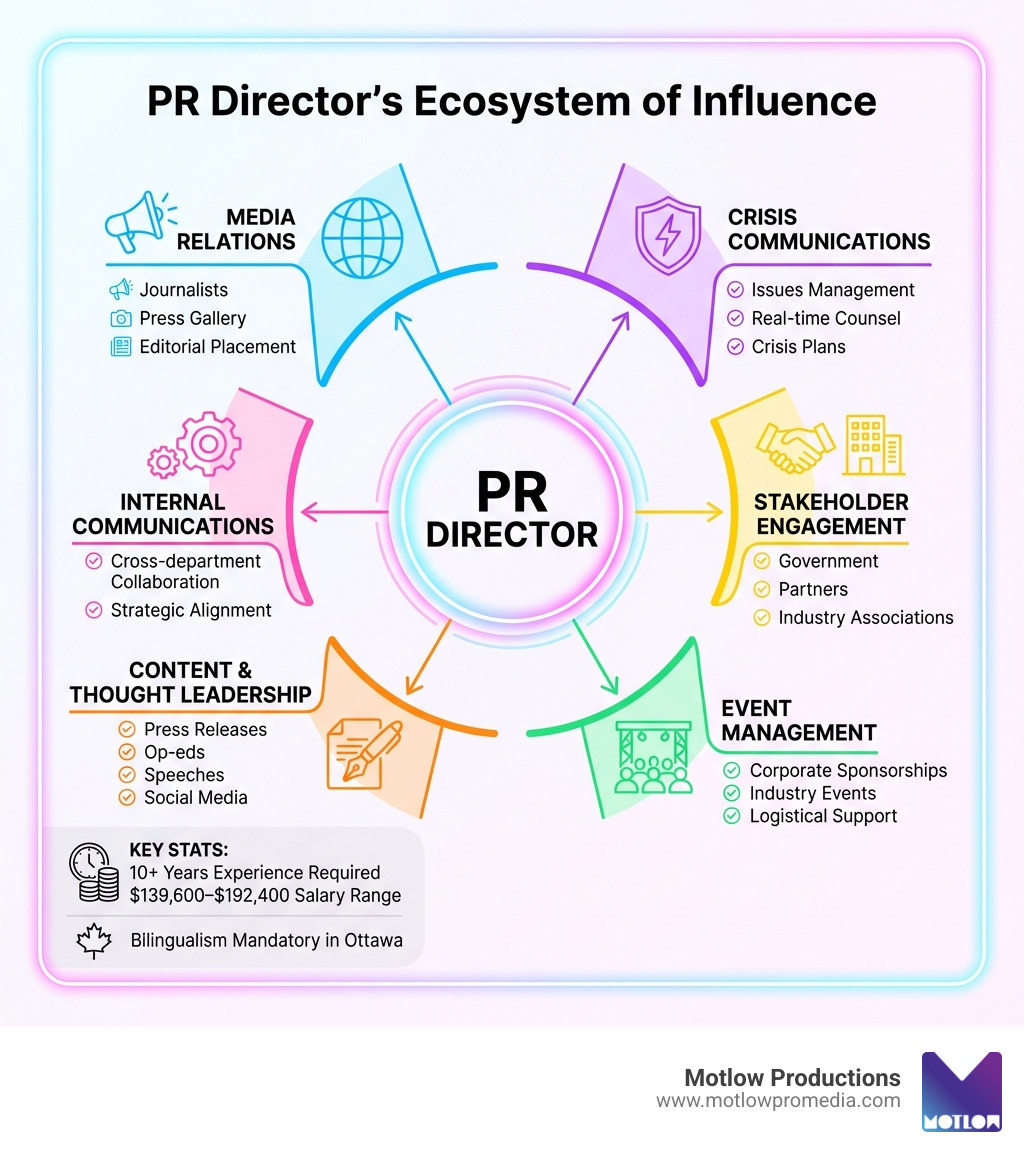
When we look at the modern landscape of corporate communications, the director public relations acts as the architect of an organization's voice. This isn't a role where you simply "check the boxes" on a daily to-do list; it is a high-level strategic position that requires a bird’s-eye view of the entire media ecosystem.

The primary job of a PR Director is to develop and execute comprehensive communication strategies that align perfectly with organizational goals. This includes building and maintaining deep-rooted relationships with key journalists, editors, and media outlets. When news breaks in seconds, having a direct line to the Public Relations Society of America (PRSA) Jobs network and major media hubs is essential. We see this often in our work at Motlow Productions; clear, strategic messaging only works if the right people are listening.
When things go wrong—and eventually, they do—the director public relations is the first person in the room. They are responsible for preparing crisis communication plans and providing real-time counsel to executive leadership. Beyond the external "firefighting," they also oversee internal communications. This ensures that employees are not the last to know about major company news, fostering a culture of transparency and alignment across departments.
A PR Director must act as the "connective tissue" between the company and its various stakeholders, including government bodies, partners, and industry associations. They monitor media trends and consumer insights to refine how the brand interacts with the world.
In the executive suite, a director public relations is a brand advocate. They don't just manage the brand; they elevate it through:
Events are a critical tool for any PR Director. Whether it’s a high-stakes press conference or a national industry summit, the Director provides logistical support and strategic oversight. They ensure that every speech, every sponsorship, and every partner relationship reinforces the brand’s leadership position. At Motlow Productions, we often partner with PR Directors to provide the live event support and content creation that makes these moments land with maximum impact.
Becoming a director public relations is a marathon, not a sprint. It requires a specific blend of formal education and a decade or more of "in the trenches" experience.
| Feature | Public Relations Manager | Director of Public Relations |
|---|---|---|
| Experience | 3–7 years | 10+ years |
| Focus | Tactical execution, team supervision | High-level strategy, budget, board reporting |
| Education | Bachelor's Degree | Bachelor's/Master's + Professional Certs |
| Reporting | Reports to Director | Reports to VP or C-Suite |
The journey almost always begins with a Bachelor’s degree in public relations, communications, journalism, or a closely related field. Many of the most successful directors come from a journalism background (much like my own), which provides a unique understanding of what makes a story "newsworthy." According to the Zippia Career Guide, this educational baseline is non-negotiable for 90% of director-level roles.
Beyond the degree, several core competencies are required:
Most professionals follow a path that starts as a PR Coordinator or Assistant, moving into a Manager role after about five years. To reach the Director level, one typically needs at least 10 years of progressive experience, with at least 3 of those years in a managerial or supervisory capacity. Building a diverse portfolio that includes crisis management, digital strategy, and successful media campaigns is the key to climbing the ladder.
The day-to-day life of a director public relations can look vastly different depending on the industry.
In the Canadian healthcare sector, the role is heavily influenced by regulatory environments and public policy. Companies like Vertex Pharmaceuticals Public Affairs or organizations like Innovative Medicines Canada require Directors who understand the "Parliamentary Press Gallery" in Ottawa.
In this sector, the PR Director is often an advocate, dealing with complex scientific data and translating it into messaging that resonates with policymakers and the public. Bilingualism (English and French) is often mandatory here, especially for roles based in Ottawa, to ensure national media reach.
Contrast this with a global hospitality brand like Marriott or a tourism entity like the Hong Kong Tourism Board. Here, the focus shifts to "always-on" storytelling across a massive portfolio of brands.
A director public relations in hospitality might manage a "Global Newsroom," a centralized function that identifies and produces high-impact stories across 30+ brands. The goal is earned media coverage that drives bookings and loyalty, requiring a deep understanding of consumer insights and digital lifestyle trends. Companies like McKesson Communications also demonstrate how large-scale corporate comms require a balance of brand storytelling and logistical excellence.
The job market for PR Directors in Canada is currently concentrated in major hubs like Toronto and Ottawa.
For a senior director public relations—especially those managing global newsrooms or high-stakes public affairs—the salary range is impressive. Statistics show an average range of $139,600 to $192,400 annually.
In Toronto, the demand is high across sectors like pharma, finance, and technology. Roles at agencies like Citizen Relations Account Director show that even on the agency side, director-level positions command significant respect and compensation due to the strategic nature of the work.
We are seeing a massive shift toward "omnichannel enablement." A PR Director is no longer just responsible for the newspaper; they oversee social media strategy, online communities, and digital growth marketing. They must understand how to use data analytics to inform their decisions, moving away from "gut feelings" toward evidence-based communication.
In Canada, particularly for roles involving the federal government or national advocacy, bilingualism is a functional necessity. A director public relations in Ottawa must be able to communicate effectively with both English and French media outlets to ensure a truly national reach. Without French proficiency, a brand risks alienating a significant portion of the Canadian market and failing to coordinate effectively with federal departments.
While the titles are often used interchangeably, there is a subtle difference in focus. A PR Director typically focuses more on external relationships—media, public perception, and brand reputation. A Communications Director often has a broader remit that includes internal communications, employee engagement, and corporate branding. In smaller organizations, one person may wear both hats, reporting directly to top management.
The role has moved from a reactive "gatekeeper" model to a proactive "content creator" model. Today’s directors must manage online communities, oversee social media managers, and use data to track how their stories are performing in real-time. The "Global Newsroom" concept is a direct result of this evolution—treating a corporate PR department like a 24/7 media outlet.
The role of a director public relations has never been more vital—or more challenging. As organizations navigate an increasingly fractured media landscape, the need for steady, strategic leadership is paramount. From managing a crisis in a boardroom to launching a global storytelling campaign, these executives are the guardians of corporate reputation.
At Motlow Pro Media, we understand the weight these directors carry. Our goal is to be the "hands-off, but hands-on" partner that makes their vision a reality. Whether it's through seamless live event support or high-end content creation, we act as a trusted extension of your team, ensuring your message is heard loud and clear.
If you're looking to elevate your organization's media presence or need a partner who understands the high stakes of executive communications, we invite you to explore our work.
Some clients want to give notes in a live Zoom call. Others prefer a group text or email thread. However you like to communicate, we adapt. You’ll never be left guessing where things stand - and you’ll always have a say before anything goes out the door.





Phone:
+1 863-250-8639
.png)
Email:
info@motlowpromedia.com