

















-5.jpg)

































































Thank you! Your submission has been received!
Oops! Something went wrong while submitting the form.

.avif)
A business content strategy is your roadmap for creating, publishing, and managing content that drives measurable business results. It goes beyond random social posts—it aligns what you say, where you say it, and who you say it to with your core business goals.
Key Elements of an Effective Business Content Strategy:
Here's the hard truth: most brands don't have a content problem. They have a clarity problem.
Poor engagement usually means your audience is confused about what you do and why it matters. When someone lands on your profile or website, they should know immediately who you help and how. If they don't, you've lost them—and confusion kills conversion every single time.
The average internet user spends roughly six hours and 40 minutes online daily. That's your window. But without a strategic plan, you're just adding to the noise instead of cutting through it.
Too many content teams operate in chaos. Ideas live in random docs, publishing dates shift weekly, and no one's quite sure what's been written or why. At enterprise scale, content rarely fails because the writing is bad—it fails because governance is vague, resourcing is brittle, and teams point in different directions.
For solo entrepreneurs and small businesses, the challenge is different but equally real. Content marketing is slow. When you need clients now, the typical advice to "just start blogging" doesn't help. That's why 80% of small businesses fail—not because of bad content, but because they lack product/market fit and waste time on tactics that don't drive immediate revenue.
The solution? A content strategy that balances quick wins with long-term authority building. One that prioritizes clarity over quantity, strategic consistency over scattered posting, and measurable outcomes over gut feelings.
I'm Miranda Motlow, and I've spent over a decade partnering with casino marketing teams and corporate clients to develop business content strategy frameworks that connect with audiences and drive results. At Motlow Pro Media, we've learned that the most effective content comes from listening first—to your goals, your audience, and your brand story—then translating those insights into video and media that feel authentic and intentional.
In this guide, you'll learn how to build a content strategy that actually works for your business—whether you're a solo entrepreneur needing fast client wins or a corporate team managing complex campaigns across multiple channels.
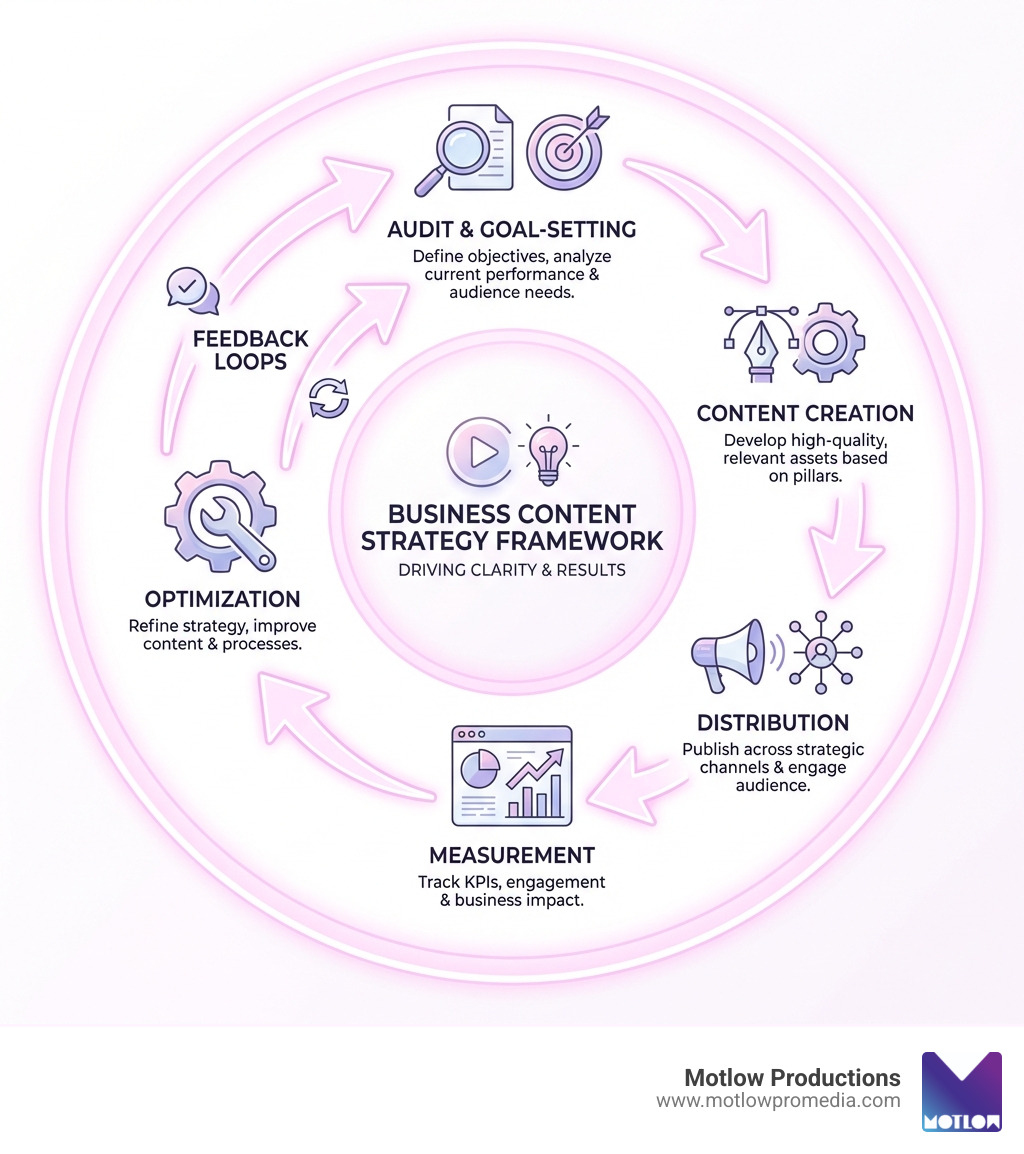
To move from "random acts of content" to a high-performing engine, you need a content strategy framework. Think of this as the skeleton of your marketing. Without it, your content is just a pile of "stuff" that doesn't hold its own weight.
We often see businesses confuse content-related tactics—like making a TikTok, writing a blog post, or designing an infographic—with strategy. Tactics are the how; strategy is the why. A business content strategy comes before tactics. It plans, clarifies, and connects every video or post to a meaningful purpose.
Research shows that 80+% of small businesses fail due to a lack of product/market fit. No amount of beautiful video production can save a business that hasn't identified a real problem it solves for a specific group of people.
Once you have that fit, you must set SMART goals. Instead of saying "we want more traffic," aim for "increase organic traffic by 20 percent in six months" or "generate 50 percent more qualified leads in 90 days."
| Feature | Reactive Posting | Intentional Strategy |
|---|---|---|
| Frequency | Whenever "inspiration" strikes | Based on a consistent editorial calendar |
| Messaging | Random topics, often self-centered | Focused on audience pain points and pillars |
| Measurement | Vanity metrics (likes, shares) | Business KPIs (leads, ROI, pipeline) |
| Outcome | Brand confusion and burnout | Brand authority and conversion |
We live in an age where the average user spends roughly six hours and 40 minutes online every single day. To get a slice of that attention, you need an Ideal Customer Profile (ICP). You shouldn't be speaking to "everyone." You should be speaking to one person.
When we talk about clarity, we mean fixing the message, not just the medium. By fixing your clarity, you can see an engagement lift of 25–40%. If you want to see how we help brands find this clarity through professional media, you can explore more info about our media services.
The "Clarity Problem" is the number one reason content fails. If we scroll through your page for 30 seconds, can we tell what you actually do and who you help? If the answer is "no," or if you're using vague jargon like "innovative digital solutions," you're losing money.
The 10-Second Rule: A new visitor should understand your value proposition within 10 seconds of landing on your site. Simplify your offer into one sentence. Instead of "We provide comprehensive corporate media leadership," try "We help corporate teams produce seamless live events and video content."
A successful business content strategy is built on a marketing funnel. You need content for every stage: Awareness (they find you), Consideration (they trust you), and Conversion (they hire you).
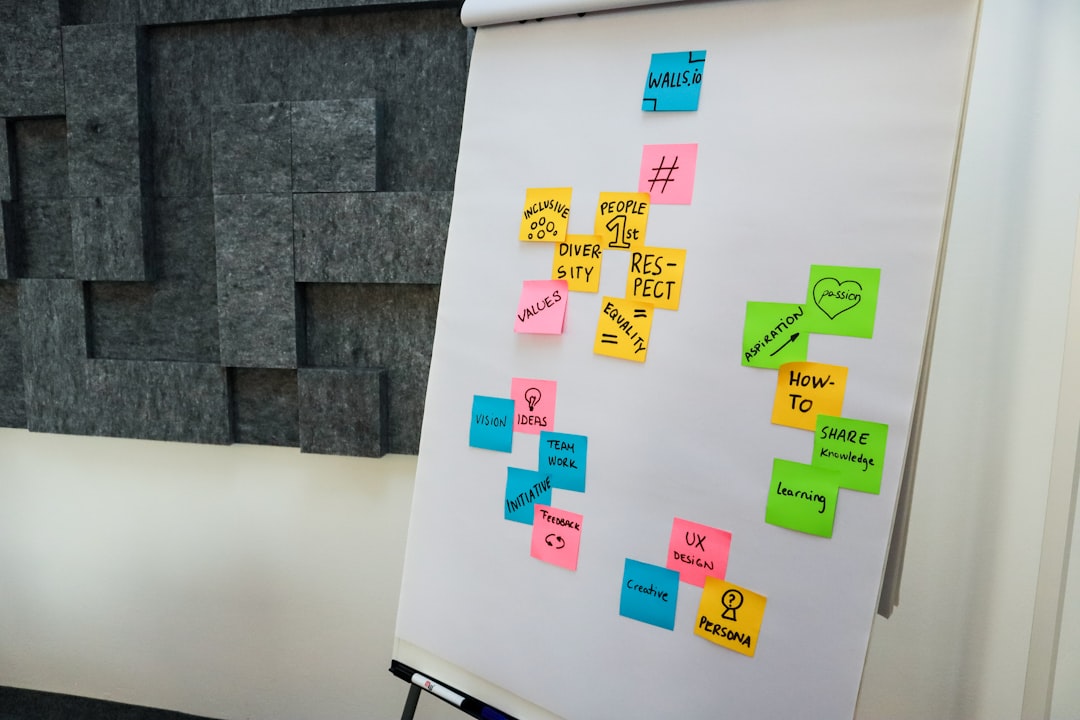
Pick three to five core themes you want to be known for. These are your content pillars. For example, a mental health app might have pillars like "Stress Management," "Daily Mindfulness," and "Peer Support."
Working in pillars ensures you don't spread yourself too thin. According to a 2023 Content Preferences Survey by Demand Gen Report, over 70% of B2B buyers prefer content that drills down into specific topic areas rather than broad, surface-level advice.
Not all platforms are created equal. You must go where your audience "hangs out."
We often recommend a "hub and spoke" model: create one "hero" asset (like a long-form interview or webinar) and break it down into smaller "spokes" (clips, quotes, blog posts). You can see examples of how we handle video storytelling on our Motlow Pro Media YouTube channel.
For more on how to create these assets, check out more info about content creation at Motlow Productions.
Once your content strategy is in motion, measuring its impact is non-negotiable. You have to move beyond gut feelings.
You don't need a massive team to track data. Start with free tools like Google Search Console to see what keywords are bringing people to your site. Use GA4 to track conversions—did that video lead to a contact form fill?
A 2023 report shows that for 10% of teams, the biggest challenge is simply a lack of tools to measure impact. Don't let that be you. Track your Customer Acquisition Cost (CAC) and compare it to the lifetime value of a client. If your content is reducing the time it takes to close a sale, that's a massive ROI win.
Building a content strategy shouldn't take a year. We recommend a 60-day sprint methodology to get results fast.
For businesses that need a partner to lead this media transition, we offer more info about media leadership to help you scale without the headache.
To help you visualize this workflow, you can download our free flowchart for digital marketing strategy.
Content strategy is the high-level planning and governance—the "internal" roadmap. Content marketing is the "external" execution—the actual act of creating and distributing those assets to attract customers. Strategy always comes first.
Consistency is more important than frequency. For most small businesses, aiming for one high-quality pillar piece (like a blog or video) per week, supplemented by 2-3 social distributions, is a sustainable and effective starting point. As you grow, you can aim for higher benchmarks, such as the SEO best practices recommendation of eight blog posts per month.
No. AI can help with keyword research, drafting, and ideation, but it cannot understand your brand's unique soul, your specific client relationships, or the nuanced "clarity" required to convert a skeptic into a fan. Use AI as a tool, but keep a human at the helm for strategy.
A winning business content strategy isn't about being everywhere at once; it's about being in the right place with the right message. By prioritizing clarity, building a structured framework, and following a disciplined 60-day roadmap, you can transform your content from a time-sink into a lead-generating asset.
At Motlow Pro Media, we believe in strategic consistency and building brand trust through high-quality media. We act as a "hands-off, but hands-on" partner, providing the media leadership you need to grow while you focus on running your business.
Ready to stop the content chaos? Craft your strategy with Motlow Pro Media and let’s build something that lasts.
Some clients want to give notes in a live Zoom call. Others prefer a group text or email thread. However you like to communicate, we adapt. You’ll never be left guessing where things stand - and you’ll always have a say before anything goes out the door.





Phone:
+1 863-250-8639
.png)
Email:
info@motlowpromedia.com