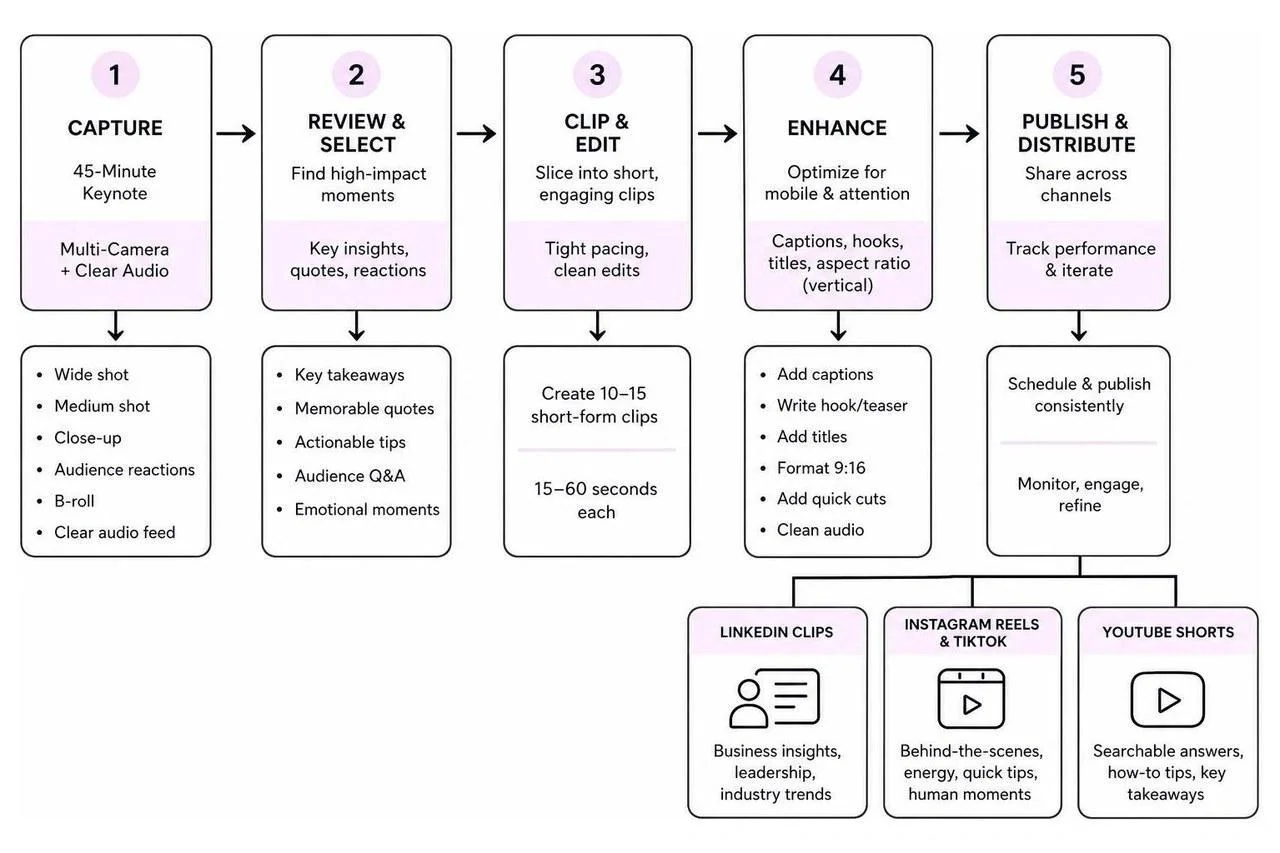
How to Repurpose One Executive Interview Into 20 Pieces of Content
One executive interview can support 20 distinct assets when questions, recording, editing, rights, and distribution are designed around specific business uses.
By Motlow Pro Media·Tampa, FL
Introduction
Executive access is valuable and often difficult to schedule, so a single interview should not be planned around only one finished video when the business has multiple communication needs. The objective is not to publish twenty repetitive clips. It is to capture a strong anchor conversation and translate its ideas into formats that serve different audiences, channels, and moments. That work begins with a content map before the interview, because repurposing depends on how questions are asked and answers are recorded.
For corporate marketing and communications teams, the planning challenge is to make decisions early enough that creative ambition and operational reality stay aligned. The topic matters because recording one polished interview that cannot be adapted without losing context can consume budget and attention without improving the audience experience. A useful process makes tradeoffs visible before they become emergencies. It also leaves a record that future projects can improve rather than reconstruct.
The recommended approach is to work backward from the intended business use and define the people, systems, approvals, and assets required to support it. Success means executive access produces a coordinated library of credible long-form and short-form content. That standard is more useful than judging the work only by how busy the production looked or how many files were delivered. Every section below turns that principle into a practical decision.
Choose Four Message Themes
Organize the interview around a small set of themes such as market perspective, customer priorities, company strategy, leadership lessons, innovation, or culture. Each theme should support a known campaign, stakeholder, or business conversation.
Prepare factual proof, examples, and sensitive boundaries so the executive can speak confidently. Themes create coherence across many outputs without forcing every asset to repeat the same point.
The practical value of choose four message themes comes from making responsibility visible. Record what must be true, who confirms it, and when the production team can rely on the answer. This protects corporate marketing and communications teams from recording one polished interview that cannot be adapted without losing context. It also gives the team a clear basis for evaluating requests that appear after the plan is approved.
For additional context, review executive interview as this part of the plan is finalized.
Record Answers That Can Stand Alone
Ask the executive to include context in each response and avoid references that depend on the previous question. Capture a complete version, a concise version, and a practical takeaway for the most important topics.
Pause between answers and maintain consistent framing, eye line, sound, and lighting. These choices give editors natural boundaries for clips, quotes, and written adaptations.
Apply this step in the creative brief, schedule, and review process instead of leaving it in meeting notes. A useful decision is specific enough for another person to act on and trace back to the audience need. Review it again before the filming or event day, when changes still can be handled deliberately. The standard is whether executive access produces a coordinated library of credible long-form and short-form content.
Build the Anchor Assets First
Create one full interview or thematic edit, one executive summary video, and several two-to-four-minute topic segments. The anchor edits establish approved context and make it easier to select accurate short excerpts.
Use chapters, captions, titles, and a clear description so longer content remains navigable. These assets can support a website, internal channel, sales follow-up, event, or leadership communication.
This is also a useful point for comparing internal capacity with outside support. Identify which decisions belong to marketing, communications, executives, subject experts, venue teams, or production specialists. Confirm the handoff and the consequence of a late answer. That structure reduces recording one polished interview that cannot be adapted without losing context without adding unnecessary process.
For additional context, review content map as this part of the plan is finalized.
Create Short Video and Audio Versions
Select focused answers for horizontal and vertical clips, then tailor openings, captions, titles, and calls to action to the platform. Extract audio for podcast segments, internal updates, or presentation playback when the message works without visuals.
Avoid cutting statements so tightly that nuance or required qualification disappears. A transcript and approved message guide help reviewers protect meaning across formats.
During approval, ask what the audience would notice if this element were missing or inconsistent. Then decide whether the requirement is essential, adaptable, or optional and make the budget reflect that choice. For corporate marketing and communications teams, the benefit is a more predictable path to executive access produces a coordinated library of credible long-form and short-form content. The team can then protect quality without treating every preference as equally critical.
For additional context, review transcript as this part of the plan is finalized.
Translate the Interview Into Written Content
The transcript can support an article, leadership email, FAQ, quote graphics, social captions, sales talking points, and a short internal memo. Written versions should adapt the idea to the reader rather than copying spoken language word for word.
Preserve the executive's intent and verify any claims, dates, names, or numbers before publication. Link written assets back to relevant video when the audience benefits from hearing the original voice.
Turn this guidance into a short checklist that can be reused on the next project. Include the evidence or file needed for approval, the person who owns the answer, and the latest responsible decision date. Reuse creates speed because the team starts from a tested standard. It also prevents recording one polished interview that cannot be adapted without losing context from returning under a different project name.
Use a Twenty Asset Map
A practical mix might include one full interview, one summary, four topic videos, eight short clips, two quote graphics, one article, one email, one FAQ, and one sales resource. The exact mix should follow business demand rather than a fixed quota.
Assign each asset an audience, channel, owner, approval path, and planned date. Track performance by theme so the next executive session can focus on the questions audiences value most.
For corporate marketing and communications teams, this section should become a documented planning decision rather than an informal expectation. Name the owner, deadline, required inputs, and approval standard connected to use a twenty asset map. Test the decision against whether executive access produces a coordinated library of credible long-form and short-form content. If an assumption changes, update the scope and the people affected before work continues.
For additional context, review platform as this part of the plan is finalized.
Putting This Into Practice
Begin with a 45-minute working session involving the marketing owner, the person responsible for production, and the stakeholders who control essential facts, access, budget, or approval. Use the discussion to rank choose four message themes, record answers that can stand alone, build the anchor assets first as immediate decisions. Capture open questions in the same brief and assign a date when each answer becomes final. This keeps discovery from becoming a permanent phase and gives the team an executable starting point.
Next, review create short video and audio versions, translate the interview into written content, use a twenty asset map against the real schedule and available capacity. Remove work that has no audience, owner, or distribution path, and protect the elements that directly support executive access produces a coordinated library of credible long-form and short-form content. If the team cannot resolve a dependency, label the impact on timing, cost, or quality instead of hiding it. Clear constraints are easier to manage than optimistic assumptions.
After delivery, hold a short review focused on decisions rather than personal preference. Note what improved audience value, what caused delay or rework, which assets were actually used, and which standards should change. Store those lessons with the brief, schedule, releases, source files, and final deliverables. This closes the loop and turns one project into operating knowledge for the next.
Planning Checklist
Choose four themes tied to real campaigns or stakeholder needs.
Prepare proof points, boundaries, and modular questions.
Capture complete, concise, and takeaway versions of priority answers.
Approve anchor edits before extracting the shortest clips.
Create video, audio, written, graphic, email, and sales formats selectively.
Assign audience, channel, owner, approval, timing, and measurement to every asset.
Frequently Asked Questions
How long should the executive interview be?
Allow enough time for thoughtful answers, follow-ups, and concise retakes. The useful duration depends on the executive, number of themes, preparation, and complexity rather than a fixed recording length. The right answer should be documented in the project brief so corporate marketing and communications teams and production partners work from the same assumption.
Should all 20 pieces publish at once?
No. Distribute them according to campaign timing and audience needs. A planned sequence prevents repetition and extends the value of the interview. The right answer should be documented in the project brief so corporate marketing and communications teams and production partners work from the same assumption.
Can AI turn the transcript into the other assets?
AI can assist with transcripts, search, summaries, and draft variations, but qualified people should review accuracy, context, brand voice, confidentiality, and executive intent. The right answer should be documented in the project brief so corporate marketing and communications teams and production partners work from the same assumption.
The Bottom Line
One executive interview can become a high-value content library when the team designs themes, questions, capture, approvals, and distribution together. The number twenty is useful as a planning model, not a production target. Every finished asset should have a distinct job and preserve the meaning and credibility of the original conversation.